 EEA geospatial data catalogue
BEAT+ Integrated classification of biodiversity condition in Europe’s seas, May 2020
The BEAT+ tool builds on the EEA assessment tools developed and applied in the context of assessing the degree of contamination (CHASE+), eutrophication (HEAT+) and biodiversity (BEAT+) in Europe's seas. BEAT+ makes use of the same data sets and threshold values used in these assessments but recombines these in a new framework that addresses 'biodiversity condition'.
BEAT+ has been designed to provide an assessment of the spatial variability of a range of biodiversity components by combining existing biodiversity indicators. The tool integrates data from normalised indicators to identify worst case status measures for different biodiversity components. The results are then linked to a standard gridE based Spatial Assessment Unit (SAU) which is used both for biodiversity and for pressures assessments (Andersen et al., 2014). These grid-based SAUs not only allow alignment of indicators for biodiversity and for pressures but provide a means for combining large assessment areas (e.g. for wide‐ranging species) with point data collected from biological surveys e.g. WFD monitoring.
BEAT+ tool works by calculating a Biological Quality Ratio (BQR) which is an aggregated score of indicator outcomes within a grid square. To allow objective comparison, the indicator outcomes are normalised to a scale of 0 to 1, with five status classes at equal intervals on that scale (from Bad starting at 0, Poor at 0.2, Medium at 0.4, Good at 0.6 and High at 0.8). By this means, indicators based on different biological criteria can be aggregated in a consistent way.
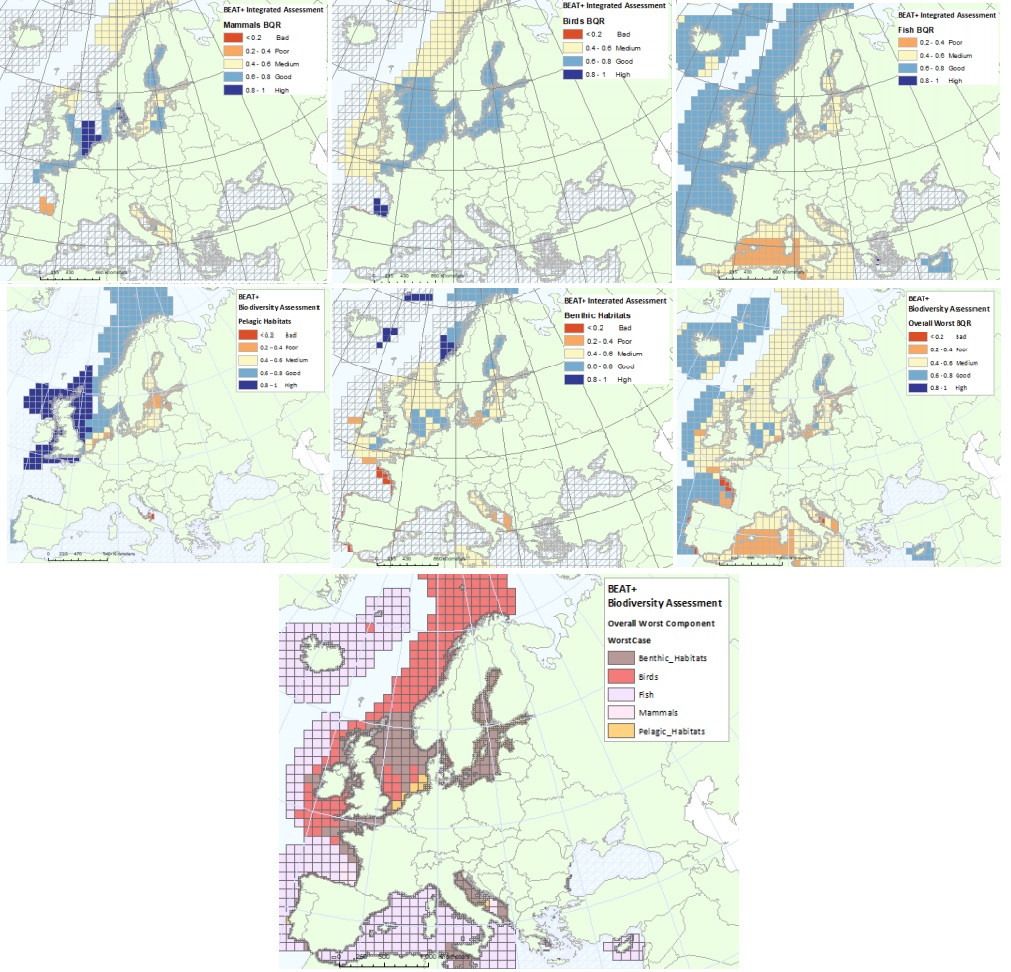
This metadata refers to dataset providing the results of classification of biodiversity status using the BEAT+ tool. The status is evaluated in five classes, where High and Good are recognised as ‘non-problem areas’ and Moderate, Poor and Bad are recognised as ‘problem areas’. The dataset covers:
- BQR Assessment of all marine mammals combined (mainly focused on coastal and relatively stable inshore populations of seals, dolphins and porpoises)
- BQR Assessment of seabirds and wading birds
- BQR Assessment of commercial fish (as these have agreed targets defined on biomass and fishing mortality)
- BQR Assessment of pelagic habitats
- BQR Assessment of benthic habitats
- BQR Assessment of worst-performing biodiversity groups
- An overall synthesis of the Biological Quality Ratios (BQR) values (showing which are the worst -lowest- BQR values in each assessment grid cell. The ‘worst’ value is used here to identify the biological group most at risk, rather than averaging over all groups to avoid over-emphasis on groups with more intensive monitoring).
As reference, please consult the ETC/ICM Report 3/2019: Biodiversity in Europe's seas: https://www.eionet.europa.eu/etcs/etc-icm/products/biodiversity-in-europes-seas. The indicator BEAT+ Integrated Assessment Worst Case BQR has been used in the EEA report 17/2019 "Marine Messages II": https://www.eea.europa.eu/publications/marine-messages-2 .
Simple
Identification info
- Date (Creation)
- 2019-05-08
- Date (Publication)
- 2020-05-27
- Edition
-
01.00
- Citation identifier
- eea_v_4258_20_km_beat_p_2011-2016_v01_r00
- Citation identifier
- DAT-235-en
- Point of contact
-
Organisation Individual Electronic mail address Website Role European Environment Agency
Point of contact European Environment Agency
Custodian
- Spatial representation type
- Vector
Spatial resolution
- Spatial resolution
- 20 km
Spatial resolution
- Spatial resolution
- 100 km
- Topic category
-
- Environment
Extent
))
Temporal extent
- Time period
- 2011-01-01 2016-12-31
- Maintenance and update frequency
- Not planned
- Continents, countries, sea regions of the world.
-
-
Norwegian Sea
-
Baltic Sea
-
Mediterranean Sea, Eastern Basin
-
North Sea
-
Bay of Biscay
-
North Atlantic Ocean
-
Mediterranean Sea
-
Kattegat
-
Mediterranean Sea, Western Basin
-
Ionian Sea
-
Adriatic Sea
-
Black Sea
-
Celtic Sea
-
Barents Sea
-
Aegean Sea
-
English Channel
-
Tyrrhenian Sea
-
- EEA Management Plan
-
-
2019 1.6.2
-
Resource constraints
- Access constraints
- Other restrictions
- Other constraints
- no limitations to public access
Resource constraints
- Use constraints
- Other restrictions
- Other constraints
-
License CC-BY 4.0 ( https://creativecommons.org/licenses/by/4.0/). Copyright holder: European Environment Agency (EEA).
- Language
- English
Data quality info
- Hierarchy level
- Dataset
Report
Result
- Title
- Commission Regulation (EU) No 1089/2010 of 23 November 2010 implementing Directive 2007/2/EC of the European Parliament and of the Council as regards interoperability of spatial data sets and services
- Date (Publication)
- 2010-12-08
- Explanation
-
See the referenced specification
Resource lineage
- Statement
-
The BEAT+ tool itself is anchored in earlier versions of the tool developed and tested by Helcom (2010a) and the EU‑funded Devotes project (Uusitalo et al., 2016; Nygård et al., 2018). The indicators used for assessing biodiversity conditions across Europe' seas range from planktonic organisms over benthic communities to fish, seabirds, reptiles and marine mammals — and each indicator is represented by two numerical values, a figure representing biodiversity and a figure representing agreed target values (e.g. from Helcom, the OSPAR Commission, maximum sustainable yield (MSY).
As reference, please consult the ETC/ICM Report 3/2019: Biodiversity in Europe's seas: https://www.eionet.europa.eu/etcs/etc-icm/products/biodiversity-in-europes-seas. The indicator BEAT+ Integrated Assessment Worst Case BQR has been used in the EEA report 17/2019 "Marine Messages II": https://www.eea.europa.eu/publications/marine-messages-2 .
- Hierarchy level
- Dataset
Reference System Information
Reference System Information
- Code
- EPSG:4258
Metadata
- Metadata identifier
- 70064384-f3b7-49ad-b137-bdf31af82158
- Language
- English
- Character encoding
- UTF8
- Contact
-
Organisation Individual Electronic mail address Website Role European Environment Agency
Point of contact
Type of resource
- Resource type
- Dataset
- Metadata linkage
-
https://sdi.eea.europa.eu/catalogue/srv/api/records/70064384-f3b7-49ad-b137-bdf31af82158
- Date info (Creation)
- 2021-07-01T11:13:44.904Z
- Date info (Revision)
- 2025-12-02T12:41:49.469766Z
Metadata standard
- Title
-
ISO 19115/19139
- Edition
-
1.0
)))