 EEA geospatial data catalogue
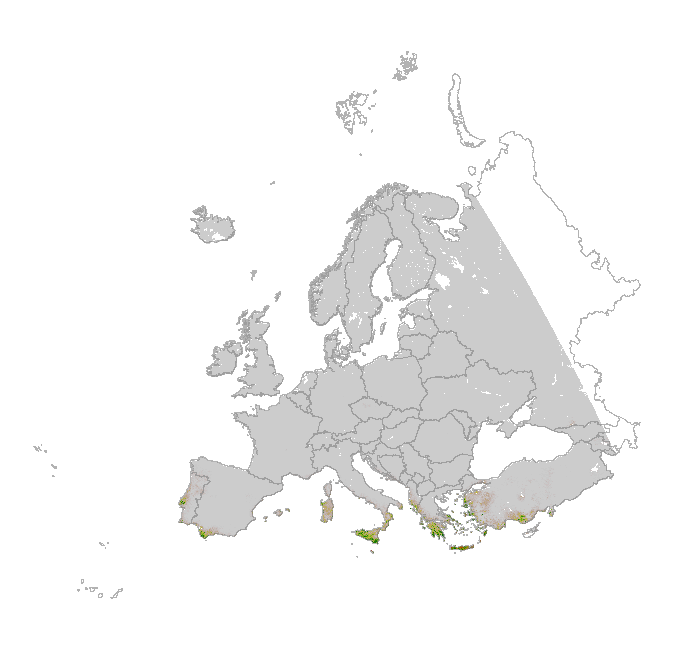
EUNIS habitat type F7.3, predicted habitat suitability - version 1, June 2016
The modelled suitability for the EUNIS habitat type is an indication of where conditions are favourable for the habitat type based on sample plot data (Braun-Blanquet database) and the Maxent software package. The modelled suitability map may be used as a proxy for the geographical distribution of the habitat type. Note however that it is not representing the actual distribution of the habitat type.
Also note that predictions are less reliable due to data deficiency in the eastern part of Europe, and to a lesser extent to the Scandinavian countries.
Geographic restriction for plot observations: n/a
Remarks: Prediction in the Iberian Penissula should be ignored.
Simple
Identification info
- Date (Publication)
- 2016-07-01
- Date (Creation)
- 2016-07-06
- Edition
-
01
- Citation identifier
- eea_r_3035_1_km_eunis-hab-f7-3_p_1940-2011_v01_r00
- Status
- Obsolete
- Point of contact
-
Organisation Individual Electronic mail address Website Role European Environment Agency
Point of contact European Environment Agency
Custodian
- Spatial representation type
- Grid
Spatial resolution
- Spatial resolution
- 1 km
- Topic category
-
- Biota
Extent
))
Extent
Temporal extent
- Time period
- 1940-01-01 2011-12-31
- Maintenance and update frequency
- Unknown
- EEA topics
-
-
Biodiversity
-
- GEMET - INSPIRE themes, version 1.0
-
-
Habitats and biotopes
-
- GEMET
-
-
terrestrial ecosystem
-
natural area
-
tundra
-
heathland
-
- Place
-
-
Europe
-
Resource constraints
- Use constraints
- Other restrictions
- Other constraints
-
License CC-BY 4.0 ( https://creativecommons.org/licenses/by/4.0/). Copyright holder: European Environment Agency (EEA).
Resource constraints
- Access constraints
- Other restrictions
- Other constraints
- no limitations to public access
- Language
- English
- Character encoding
- UTF8
Data quality info
- Hierarchy level
- Dataset
Report
Result
- Title
-
Commission Regulation (EU) No 1089/2010 of 23 November 2010 implementing Directive 2007/2/EC of the European Parliament and of the Council as regards interoperability of spatial data sets and services
- Date (Publication)
- 2010-12-08
- Explanation
-
See the referenced specification
Resource lineage
- Statement
-
The database compiled for the Braun-Blanquet project is a compilation of various national and regional vegetation databases. The maintenance of these databases is in principle in the hands of the custodians. However, before uploading the databases into Braun-Blanquet database a quality check is performed by Alterra and Masaryk University. If possible, detected errors are corrected and reported back to the data provider. For the modelling of the habitat suitability map the Maxent software is used ( https://biodiversityinformatics.amnh.org/open_source/maxent/). The grid values in the map represent the probability (ranging from 0-1) that the cell is suitable for the habitat.
The grid file represents the habitat suitability of the EUNIS type. For the modelling the widely used software Maxent for maximum entropy modelling of species’ geographic distributions was used. Maxent is a general-purpose machine-learning method with a simple and precise mathematical formulation, and has a number of aspects that make it well-suited for species distribution modelling when only presence (occurrence) data but not absence data are available (Philips et al. 2006). Because EUNIS habitats have a particular species composition, they are assumed to respond to specific ecological requirements, allowing us to generate correlative estimates of geographic distributions. Modelling habitats that have been floristically defined is a well-known procedure for ecological modelling at local scales, and a promising technique to be applied also at the continental level.
The Maxent method considers presence data (known observations of a given entity) and the so-called background data. Background data comprise a set of points used to describe the environmental variation of the study area according to the available environmental layers. It is assumed that these layers represent well the most important ecological gradients on a European scale. As layers the following environmental parameters have been used: Potential Evapotranspiration, Topsoil pH, Solar radiation, Temperature Seasonality (standard deviation *100), Mean Temperature of Wettest Quarter, Annual Precipitation, Precipitation Seasonality (Coefficient of Variation), Precipitation of Warmest Quarter & Distance to water (rivers, lakes, sea).
Statistical output of the model:
#Training samples: 54
Regularized training gain: 3.6547
Unregularized training gain: 3.9416
Iterations: 500
Training AUC: 0.9935
#Test samples: 5
Test gain: 3.456
Test AUC: 0.9902
AUC Standard Deviation: 0.002
#Background points: 5054
bio_12_etrs2_ras contribution: 0
bio_15_etrs2_ras contribution: 49.1531
bio_18_etrs2_ras contribution: 23.7552
bio_4_etrs2_ras contribution: 13.0809
bio_8_etrs2_ras contribution: 0.1344
bld_m_sd1_1km_eu_ll contribution: 0.1621
cecsum_m_sd1_1km_eu_ll contribution: 0.0163
clyppt_m_sd1_1km_eu_ll contribution: 1.3448
crfvol_m_sd1_1km_eu_ll contribution: 0.2328
dist2water1km contribution: 0.0032
orcdrc_m_sd1_1km_eu_ll contribution: 1.0544
pet_he_yr contribution: 10.193
phihox_m_sd1_1km_eu_ll contribution: 0.6572
sltppt_m_sd1_1km_eu_ll contribution: 0.0147
sndppt_m_sd1_1km_eu_ll contribution: 0.0856
solar_1km contribution: 0.1124
bio_12_etrs2_ras permutation importance: 0
bio_15_etrs2_ras permutation importance: 66.3024
bio_18_etrs2_ras permutation importance: 0.1262
bio_4_etrs2_ras permutation importance: 23.4347
bio_8_etrs2_ras permutation importance: 0.3119
bld_m_sd1_1km_eu_ll permutation importance: 0.1595
cecsum_m_sd1_1km_eu_ll permutation importance: 0.0405
clyppt_m_sd1_1km_eu_ll permutation importance: 0.0262
crfvol_m_sd1_1km_eu_ll permutation importance: 0.6285
dist2water1km permutation importance: 0
orcdrc_m_sd1_1km_eu_ll permutation importance: 1.2308
pet_he_yr permutation importance: 2.7829
phihox_m_sd1_1km_eu_ll permutation importance: 3.6757
sltppt_m_sd1_1km_eu_ll permutation importance: 0.8761
sndppt_m_sd1_1km_eu_ll permutation importance: 0.0595
solar_1km permutation importance: 0.3452
Entropy: 4.8843
Prevalence (average of logistic output over background sites): 0.0121
Fixed cumulative value 1 cumulative threshold: 1
Fixed cumulative value 1 logistic threshold: 0.0036
Fixed cumulative value 1 area: 0.1173
Fixed cumulative value 1 training omission: 0
Fixed cumulative value 1 test omission: 0
Fixed cumulative value 1 binomial probability: 2.22E-05
Fixed cumulative value 5 cumulative threshold: 5
Fixed cumulative value 5 logistic threshold: 0.0458
Fixed cumulative value 5 area: 0.0386
Fixed cumulative value 5 training omission: 0
Fixed cumulative value 5 test omission: 0
Fixed cumulative value 5 binomial probability: 8.55E-08
Fixed cumulative value 10 cumulative threshold: 10
Fixed cumulative value 10 logistic threshold: 0.1365
Fixed cumulative value 10 area: 0.0239
Fixed cumulative value 10 training omission: 0
Fixed cumulative value 10 test omission: 0
Fixed cumulative value 10 binomial probability: 7.87E-09
Minimum training presence cumulative threshold: 12.7992
Minimum training presence logistic threshold: 0.1708
Minimum training presence area: 0.0198
Minimum training presence training omission: 0
Minimum training presence test omission: 0
Minimum training presence binomial probability: 3.03E-09
10 percentile training presence cumulative threshold: 19.3516
10 percentile training presence logistic threshold: 0.2726
10 percentile training presence area: 0.014
10 percentile training presence training omission: 0.0926
10 percentile training presence test omission: 0.2
10 percentile training presence binomial probability: 1.93E-07
Equal training sensitivity and specificity cumulative threshold: 13.1147
Equal training sensitivity and specificity logistic threshold: 0.1738
Equal training sensitivity and specificity area: 0.0194
Equal training sensitivity and specificity training omission: 0.0185
Equal training sensitivity and specificity test omission: 0
Equal training sensitivity and specificity binomial probability: 2.74E-09
Maximum training sensitivity plus specificity cumulative threshold: 12.7992
Maximum training sensitivity plus specificity logistic threshold: 0.1708
Maximum training sensitivity plus specificity area: 0.0198
Maximum training sensitivity plus specificity training omission: 0
Maximum training sensitivity plus specificity test omission: 0
Maximum training sensitivity plus specificity binomial probability: 3.03E-09
Equal test sensitivity and specificity cumulative threshold: 15.5867
Equal test sensitivity and specificity logistic threshold: 0.2255
Equal test sensitivity and specificity area: 0.0168
Equal test sensitivity and specificity training omission: 0.037
Equal test sensitivity and specificity test omission: 0
Equal test sensitivity and specificity binomial probability: 1.35E-09
Maximum test sensitivity plus specificity cumulative threshold: 15.5867
Maximum test sensitivity plus specificity logistic threshold: 0.2255
Maximum test sensitivity plus specificity area: 0.0168
Maximum test sensitivity plus specificity training omission: 0.037
Maximum test sensitivity plus specificity test omission: 0
Maximum test sensitivity plus specificity binomial probability: 1.35E-09
Balance training omission, predicted area and threshold value cumulative threshold: 2.0977
Balance training omission, predicted area and threshold value logistic threshold: 0.0103
Balance training omission, predicted area and threshold value area: 0.073
Balance training omission, predicted area and threshold value training omission: 0
Balance training omission, predicted area and threshold value test omission: 0
Balance training omission, predicted area and threshold value binomial probability: 2.08E-06
Equate entropy of thresholded and original distributions cumulative threshold: 8.8366
Equate entropy of thresholded and original distributions logistic threshold: 0.1086
Equate entropy of thresholded and original distributions area: 0.0261
Equate entropy of thresholded and original distributions training omission: 0
Equate entropy of thresholded and original distributions test omission: 0
Equate entropy of thresholded and original distributions binomial probability: 1.21E-08
- Hierarchy level
- Dataset
Reference System Information
Reference System Information
- Code
- EPSG:3035
Metadata
- Metadata identifier
- 4e5fa870-cd3b-4b2b-aceb-c1bbb80fcf5d
- Language
- English
- Character encoding
- UTF8
- Contact
-
Organisation Individual Electronic mail address Website Role European Environment Agency
Point of contact
Type of resource
- Resource type
- Dataset
- Metadata linkage
-
https://sdi.eea.europa.eu/catalogue/srv/api/records/4e5fa870-cd3b-4b2b-aceb-c1bbb80fcf5d
- Date info (Creation)
- 2016-06-15T13:21:59Z
- Date info (Revision)
- 2025-10-09T10:49:44.911881Z
Metadata standard
- Title
-
ISO 19115/19139
- Edition
-
1.0
)))