 EEA geospatial data catalogue
Assessment of contamination status using CHASE+ excluding metals, Mar. 2019
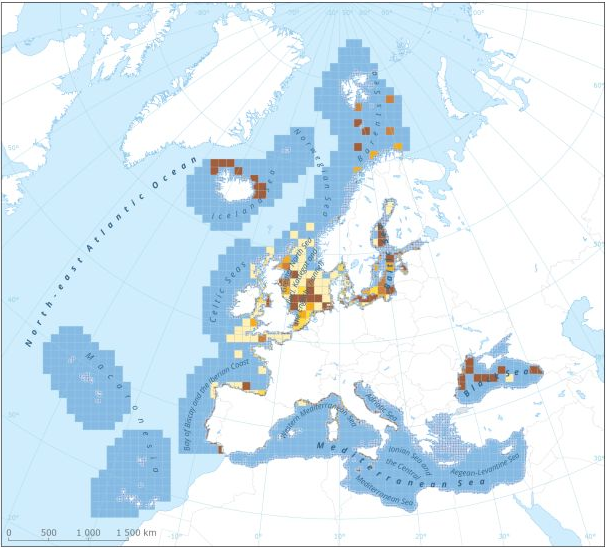
This dataset presents the resulting assessment grid (based on the EEA reference grid) with the classification of chemical status of the transitional, coastal and marine waters in the context of the Water Framework Directive (WFD) and the Marine Strategy Framework Directive (MSFD). This classification has been performed using the CHASE+ tool, with classifications of the matrices ‘water’, ‘sediment’ and ‘biota’ and indicators of ‘biological effects’, as well as an integrated classification of chemical status, combining results of all matrices. The chemical status is evaluated in five classes, where NPAhigh and NPAgood are recognised as ‘non-problem areas’ and PAmoderate, PApoor and PAbad are recognised as ‘problem areas’. This is the assessment made excluding concentrations of metals.
The overall area of interest used is based on the marine regions and subregions under the Marine Strategy Framework Directive. Additionally, Norwegian (Barent Sea and Norwegian Sea) and Icelandic waters (’Iceland Sea’) have been added (see Surrounding seas of Europe). Note that within the North East Atlantic region only the subregions within EEZ boundaries (~200 nm) have been included.
This dataset underpins the findings and cartographic representations published in the report "Contaminants in Europe's Seas" (EEA, 2019).
Simple
Identification info
- Date (Creation)
- 2019-03-06
- Date (Publication)
- 2019-03-21
- Edition
-
01.00
- Citation identifier
- eea_v_3035_20_km_chase-exclmetals_p_2009-2016_v01_r00
- Citation identifier
- DAT-211-en
- Point of contact
-
Organisation Individual Electronic mail address Website Role European Environment Agency
Point of contact European Environment Agency
Custodian
- Spatial representation type
- Vector
Spatial resolution
- Spatial resolution
- 20 km
Spatial resolution
- Spatial resolution
- 100 km
- Topic category
-
- Environment
Extent
))
Temporal extent
- Time period
- 2009-01-01 2016-12-31
Extent
- Maintenance and update frequency
- As needed
- GEMET
-
-
indicator-based assessment
-
marine biota
-
environmental quality
-
contamination
-
environmentally dangerous substance
-
sea water
-
sea
-
marine sediment
-
good chemical status
-
- Continents, countries, sea regions of the world.
-
-
Black Sea
-
Baltic Sea
-
Ionian Sea
-
North Sea
-
Celtic Sea
-
Bay of Biscay
-
Mediterranean Sea
-
Norwegian Sea
-
Iceland Sea
-
Adriatic Sea
-
English Channel
-
Aegean Sea
-
Kattegat
-
Barents Sea
-
- EEA Management Plan
-
-
2018 1.6.2
-
- EEA topics
-
-
Chemicals
-
Seas and coasts
-
Water
-
Biodiversity
-
Pollution
-
Resource constraints
- Use constraints
- Other restrictions
- Other constraints
-
License CC-BY 4.0 ( https://creativecommons.org/licenses/by/4.0/). Copyright holder: European Environment Agency (EEA).
Resource constraints
- Access constraints
- Other restrictions
- Other constraints
- no limitations to public access
Associated resource
- Association Type
- Cross reference
- Metadata Reference
Associated resource
- Association Type
- Cross reference
- Metadata Reference
- Language
- English
Distribution Information
- Distribution format
-
-
SHP
-
- OnLine resource
-
Direct download
- OnLine resource
-
Contaminants in Europes seas INPUT material
- OnLine resource
-
Contaminants in Europes seas RESULTS-material
Data quality info
- Hierarchy level
- Dataset
Report
Result
- Title
- Commission Regulation (EU) No 1089/2010 of 23 November 2010 implementing Directive 2007/2/EC of the European Parliament and of the Council as regards interoperability of spatial data sets and services
- Date (Publication)
- 2010-12-08
- Explanation
-
See the referenced specification
Resource lineage
- Statement
-
This assessment is based on data on contaminants, monitored in transitional, coastal and marine waters in the context of the WFD and the MSFD. The part of reported data from water, sediment and biota, as well as the information about biological effects, are derived from the DOME data portal of the International Council for the Exploration of the Sea (ICES). Other key data sources are data reported under the European Environment Information and Observation Network (Eionet), EMODnet Chemistry (the Baltic Sea and the Black Sea) and the EMBLAS project (Black Sea). In addition, France and Portugal have made new data sets available. For this analysis, Europe's seas were divided into grid cells of 20 × 20 km2 in coastal waters and 100 × 100 km2 in offshore areas. The CHASE+ methodology is a simple five-step procedure applied in every assessment unit. The five steps are: Step (1): substances/indicators are grouped into four categories (C1: water; C2: sediment; C3: biota, C4: biological effects). Step (2): for each individual substance/indicator, a contaminant ratio (CR = Cstatus/Cthreshold) is calculated. Step (3): for categories C1-3, a contamination score (CS) is calculated. Step (4): each category is subdivided into five status classes with class boundaries: 0.0-0.5 (NPAhigh), 0.5-1.0 (NPAgood), 1.0-5.0 (PAmoderate), 5.0-10.0 (PApoor) and > 10.0 (PAbad). Step (5): category-specific classifications are subsequently combined for each assessment unit into an integrated classification of 'non-problem area' (NPA) or 'problem area' (PA) by using the worst classification — the 'one-out, all-out' principle.
Based on the EEA reference grid, two grids have been developed covering the Marine Regions and Sub-regions of Europe. The first grid 100x100 km cell is used in offshore areas (> 20 km from the coastline); the second grid 20x20 km covers the coastal areas (<= 20 km from the coastline). The grid sizes were chosen after an evaluation of data availability versus the need for sufficient detail in the resulting assessment. Each cell in the grids has a unique identification defined from the lower left UTM coordinates. The CHASE+ results are associated to the unique cells in the grids.
More information can be found in the report "Contaminants in Europe's seas" and online material on https://www.eea.europa.eu/publications/contaminants-in-europes-seas/.
- Hierarchy level
- Dataset
Reference System Information
Reference System Information
- Code
- EPSG:3035
Metadata
- Metadata identifier
- 5d2e8632-245e-41ad-9a7b-be78f4f4597d
- Language
- English
- Character encoding
- UTF8
- Contact
-
Organisation Individual Electronic mail address Website Role European Environment Agency
Point of contact
Type of resource
- Resource type
- Dataset
- Metadata linkage
-
https://sdi.eea.europa.eu/catalogue/srv/api/records/5d2e8632-245e-41ad-9a7b-be78f4f4597d
- Date info (Creation)
- 2019-04-17T08:16:05Z
- Date info (Revision)
- 2025-10-09T10:52:50.939453Z
Metadata standard
- Title
-
ISO 19115/19139
- Edition
-
1.0
)))